Silicone-Coated Flat Roofs: Rot, Repair, or Replace?
Worried about rot under a silicone-coated flat roof? Learn why it’s hard to repair, what a proper fix involves, and when it makes sense to replace instead of patch.
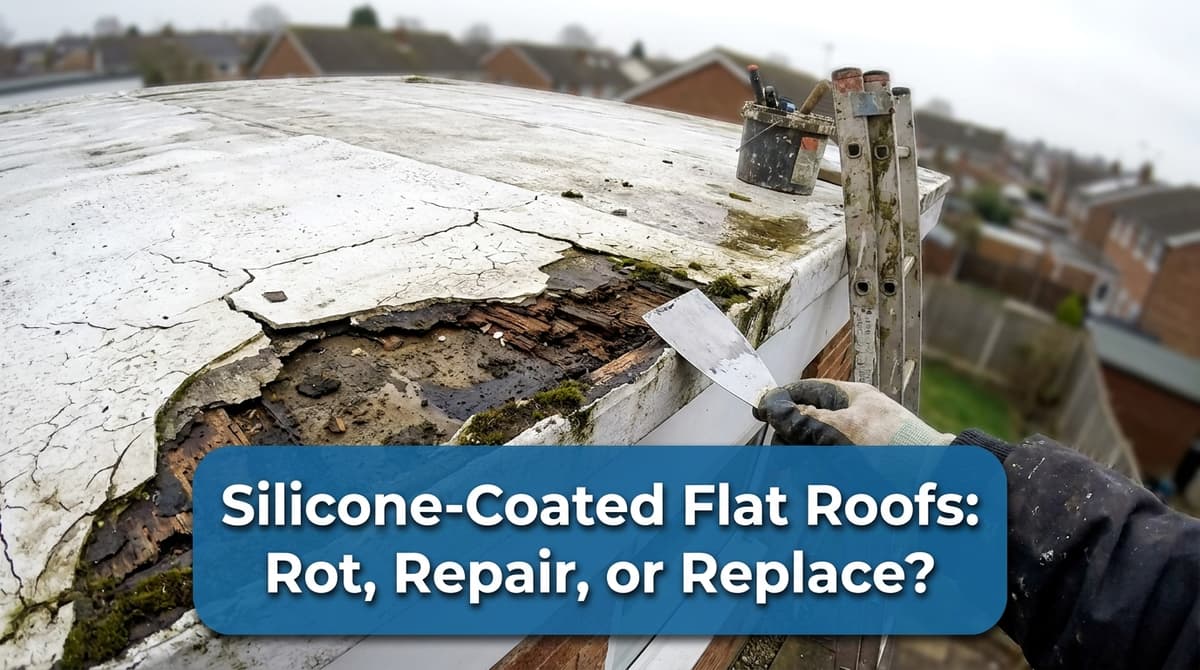
When a Silicone-Coated Flat Roof Starts to Rot
We recently got a call from a homeowner — let’s call him Mike — who was worried about the flat roof on the back of his house. The front of his home has a nice pitched shingle roof, but the back portion is a low-slope/flat area that had been coated with silicone years ago.
Mike told us, “I know some of the wood underneath has rotted out. Because it’s silicone, it’s very difficult to repair. I’m guessing you’d have to strip all the silicone, replace the bad wood, and then put a new membrane on it — not silicone this time.”
That’s actually a pretty sharp diagnosis for a homeowner, and it’s a situation we see a lot. If you’ve got a silicone-coated flat roof and you’re worried about hidden rot or wondering if you should repair or replace, this guide is for you.
Why Silicone Coatings Are Popular (and Their Downsides)
Silicone roof coatings can be a good option in the right situation. They’re often used to extend the life of an existing flat roof without a full tear-off.
Some key pros of silicone coatings:
- Seamless waterproof layer that can seal small cracks and seams.
- Highly reflective, which can reduce heat gain and lower cooling costs.
- Fast installation compared to a full roof replacement.
But there are some important cons to keep in mind:
- They don’t fix bad decking. If the wood under your roof is already damaged or poorly ventilated, a coating can actually trap moisture.
- Repairs are tricky. New coatings don’t always bond well to older, dirty, or weathered silicone.
- Future tear-offs are harder. Removing a thick, adhered coating to reach the wood below is labor-intensive and costly.
In other words, silicone works best as a tune-up for a solid roof — not a band-aid for structural problems.
Why Rot Under Silicone Is So Hard to Fix
Mike already suspected one of the biggest issues: once silicone is down, it can hide a lot. You usually can’t see rotted decking until the damage is advanced.
Here’s why rotted wood under a coated flat roof is such a challenge:
- The coating is continuous. There are no easy seams to peel back for localized repairs.
- Water travels. A leak might show up 10–20 feet away from where the decking is actually bad.
- Soft spots grow. Once the wood gets spongy, every step compacts and breaks it down further.
Trying to “patch” from the top, without opening things up, almost always leads to chasing leaks year after year. That’s why, in many cases like Mike’s, we recommend planning for a more thorough repair or full replacement.
What’s Involved in Stripping Silicone and Fixing the Deck
When we come out to inspect a coated flat roof, we start by walking it carefully (where it’s safe) and looking for soft areas, ponding water, and cracks or blisters in the coating. From there, a proper repair typically follows this general process:
1. Removing the Old Coating and Roof Layers
On problem sections, we have to cut through the silicone and any underlying materials to expose the wood deck. This can involve:
- Mechanically scraping or cutting through the coating.
- Removing old membranes or built-up roofing under the silicone.
- Taking out fasteners to lift sections and see the actual decking.
This step takes time, which is why repairs on coated roofs are more expensive than on untreated roofs.
2. Replacing Damaged Wood
Once the deck is exposed, we inspect for rot, mold, or delamination. Any compromised wood has to go. A good contractor will:
- Cut out soft or rotten plywood or OSB.
- Check rafters or joists below if rot was severe.
- Install new decking that’s properly fastened and level.
Skipping this step or leaving marginal wood in place is a recipe for future sagging and leaks.
3. Installing a New Flat Roof Membrane
This is where many homeowners, like Mike, decide not to go back to a coating alone. Instead, we usually recommend a modern membrane system such as:
- TPO (single-ply, heat-welded seams, reflective surface).
- PVC (similar to TPO, excellent chemical and UV resistance).
- Modified bitumen (multi-layer, asphalt-based, good for small or complex roofs).
In some cases, we may still add a reflective coating on top of a membrane in the future — but the membrane becomes the primary waterproofing layer, not the coating.
Repair or Replace? How to Decide
Homeowners often ask what Mike asked us: “Is it worth trying to repair this, or should I just replace the whole thing?” The answer depends on a few key factors.
Signs You Can Probably Repair
You may be a good candidate for a targeted repair if:
- The roof is relatively young and otherwise in good condition.
- Rot or softness is limited to one or two small areas.
- There’s no ongoing leak inside the home (or the leak is clearly traceable).
- You haven’t already done multiple patches in the same spots.
In these situations, opening up the problem area, fixing the decking, and installing new membrane over that section can buy you several more years of service.
Signs It’s Time for Full Replacement
On the other hand, you’re usually better off with a full tear-off and new system when:
- The flat roof is 15–20+ years old, or the history is unknown.
- Multiple areas feel spongy or uneven underfoot.
- You’ve had recurring leaks or water staining inside.
- There are multiple layers of old roofing and coatings already in place.
- The roof’s slope and drainage are poor, with regular ponding water.
At that point, continuing to patch is like putting duct tape on a rusted car frame. You’ll spend money over and over without addressing the real problem — the compromised structure and worn-out system.
What to Expect During a Full Flat Roof Replacement
For roofs like Mike’s, where we suspect widespread rot under a silicone coating, we’ll usually recommend:
- Complete tear-off of the coating and underlying roof layers down to the wood deck.
- Decking replacement anywhere the wood is soft, stained, or out of level.
- Upgraded drainage (tapered insulation, scuppers, or additional drains) to reduce ponding.
- New membrane system with properly sealed edges, seams, and penetrations.
Yes, it’s a larger project up front — but you end up with a clean, warrantied system and a solid deck, instead of layers of mystery under a shiny coating.
Thinking About Your Own Silicone-Coated Flat Roof?
If you’re in the same boat as Mike — a flat roof out of sight on the back of the house, coated with silicone, and you suspect rot — the best first step is a professional inspection. We’ll walk the roof, check the drainage, look for soft spots, and, if needed, open up a test area so we’re not just guessing what’s under there.
From there, we can talk through real options and real numbers, whether that’s a strategic repair or a full replacement with a modern membrane system. Either way, the goal is the same: get you a flat roof that’s dry, safe, and built to last — not just shiny on top.