7 Signs it's Time to Replace Your Asphalt Shingle Roof
Learn the 7 warning signs indicating you need a new asphalt shingle roof before leaks start.
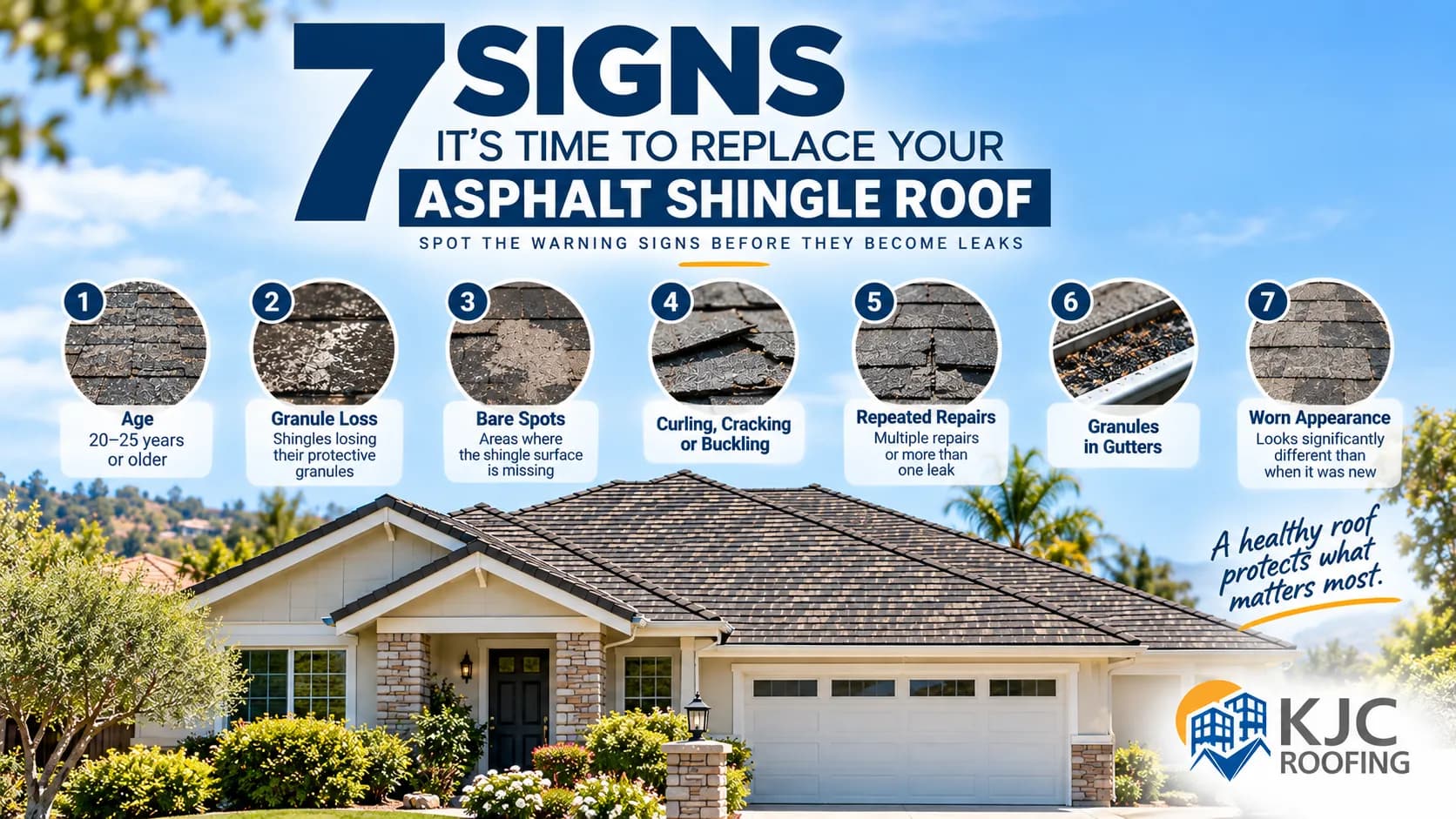
How to Tell If Your Asphalt Shingle Roof Needs to Be Replaced Before It Leaks
Is your asphalt shingle roof getting old? Here are the warning signs homeowners should look for before a small roofing problem turns into a major leak.
Most homeowners don't think about their roof very often — and that's actually a good thing. When your roof is doing its job, it quietly protects your home from the sun, wind and rain without demanding much attention.
The problem is that a roof can be nearing the end of its useful life long before it starts leaking inside your home.
If you have an older asphalt or composition shingle roof, there are several warning signs you can look for from the ground that may tell you it's time to start planning for a replacement.
How Old Is Your Asphalt Shingle Roof?
The first question is simple:
How old is your roof?
Many of the older asphalt shingle roofs we encounter in Southern California were designed around a 20–25 year service life. If your roof is approaching or has passed that age, it doesn't necessarily mean that it will suddenly fail — but it does mean you should have the roof professionally inspected and start paying closer attention to its condition.
Today's asphalt shingle systems have come a long way. Depending on the product selected, modern shingles can provide approximately 30 years of service or more, along with improved warranties, algae resistance, wind performance and reflective technology.
That means replacing an aging 20–25-year-old roof isn't simply replacing an old roof with the same thing. Today's roofing systems can provide homeowners with significant improvements in performance and energy efficiency.
Don't Wait for the First Leak
One of the biggest mistakes homeowners make is assuming:
"If it isn't leaking, the roof must be okay."
Unfortunately, that's not always true.
By the time water appears as a stain on your ceiling, it has already traveled through the roofing system and into the structure of your home. Depending on how long the problem has existed, there may already be damage to the underlayment, roof decking, insulation or other building materials.
A roof replacement is much easier to plan when you're dealing with an aging roof that is showing signs of deterioration — rather than waiting until the next major rainstorm exposes a failure.
7 Signs Your Asphalt Shingle Roof May Be Nearing the End
1. Your Roof Is 20–25 Years Old or Older
Age is one of the biggest indicators.
If your asphalt shingle roof is original to a home built 20, 25 or even 30 years ago, it's worth having it evaluated even if it appears to be doing fine from the ground.
Southern California's intense sunlight and UV exposure can accelerate the aging process, particularly on roofs that receive direct sunlight throughout the day.
If you don't know the age of your roof, check your home improvement records, ask the previous homeowner or look for documentation from a previous roofing contractor.
2. Your Shingles Are Losing Their Granules
This is one of the most important warning signs homeowners can actually see.
Asphalt shingles are covered with protective mineral granules. These granules help protect the shingle from the sun and weather.
As shingles age, those granules can begin to loosen and wash away.
Look inside your gutters and downspouts. If you're finding a noticeable amount of roofing granules collecting there, it may be a sign that your shingles are deteriorating.
You can also look at the roof itself.
Areas where the shingles have lost significant amounts of granules may appear smoother, darker or unusually shiny when sunlight hits them directly.
That's because the protective granular surface is wearing away and exposing the underlying asphalt-coated surface.
In other words, sometimes a roof that looks unusually shiny isn't a healthy roof — it may be a roof that's losing its protective surface.
3. You See "Bald" or Bare Spots on the Shingles
Take a look at your roof from the ground.
Do some shingles appear to have areas where the textured surface is missing?
These bare or "bald" areas are another indication of significant granule loss.
A few isolated areas may be repairable. But when granule loss is widespread across the roof, it can indicate that the entire shingle system is aging rather than one isolated area simply needing a repair.
4. Your Shingles Are Curling, Cracking or Buckling
Healthy asphalt shingles should generally lie relatively flat and maintain their intended shape.
As they age, you may begin seeing:
Curling edges
Cracked shingles
Buckled shingles
Raised or distorted areas
Shingles that appear brittle or worn
Missing sections of shingles
These conditions can create vulnerable areas where wind-driven rain can get underneath the roofing system.
If you're seeing these conditions across multiple areas of the roof, it's time to have the entire roof evaluated rather than simply replacing a few individual shingles.
5. You Have Repeated Repairs or More Than One Leak
A single damaged shingle doesn't necessarily mean you need a new roof.
But if you're finding yourself calling a roofer repeatedly because different areas of the roof are leaking, that's a different story.
Think of it this way:
If you keep repairing different parts of an aging roof, the problem may no longer be one damaged area — it may be the age and condition of the roofing system itself.
Repeated repairs can become expensive, and they don't necessarily address the underlying deterioration of the shingles or waterproofing layers.
6. You Notice Excessive Shingle Granules in Your Gutters
Your gutters can actually tell you quite a bit about your roof.
The next time you're cleaning your gutters, look for a buildup of small, gritty particles that resemble coarse sand.
Some granule loss is normal over the life of a shingle. However, significant or increasing amounts of granules can indicate that the shingles are deteriorating.
If you're finding large quantities of granules after rainstorms, especially on an older roof, that's a good reason to schedule an inspection.
7. Your Roof Looks Significantly Different From When It Was New
Sometimes the easiest way to identify an aging roof is simply to look at it.
Does the roof have:
Uneven coloring?
Large areas that appear worn?
Smooth or shiny patches?
Missing granules?
Curling or damaged shingles?
Numerous previous repair areas?
Areas that look substantially different from the rest of the roof?
Your roof doesn't have to look dramatically damaged to be approaching the end of its service life.
In fact, the goal is to identify these warning signs before the roof fails.
What About Dark Streaks on the Roof?
Dark streaks don't automatically mean your roof needs to be replaced.
In many cases, those dark or black streaks are caused by algae growth, which is particularly common in areas that stay damp or shaded.
Modern asphalt shingles are available with algae-resistant technologies designed to help reduce this type of discoloration.
However, if the roof is also old, losing granules, curling or showing other signs of deterioration, the staining may simply be one more indication that it's time for a professional inspection.
Today's Shingles Offer More Than Just a New Appearance
If you're replacing an older asphalt shingle roof, one of the biggest advantages is that you're not simply putting another 20-year-old roofing system on your home.
Modern asphalt shingles can offer:
Longer expected service life
Today's quality architectural shingles can provide approximately 30 years of service or more, depending on the product, installation, ventilation, maintenance and local environmental conditions.
Improved algae resistance
Many modern shingle products incorporate algae-resistant technology to help reduce the black streaking and discoloration commonly seen on older roofs.
Cool-roof technology
This is especially important for Southern California homeowners.
Certain modern asphalt shingles are manufactured with reflective granule technology designed to reflect more solar energy away from the roof.
These products, such as GAF Timberline HDZ RS shingles, can qualify as California Cool® / cool-roof-rated shingles as they meet the 2025 California Title 24 cool-roof requirements.
The benefit is more than just a different-looking shingle. A reflective roof surface can absorb less solar heat, potentially helping reduce heat transfer into the home and improve summertime comfort.
For homeowners in Southern California, where roofs can sit under intense sunlight for hours every day, that's an important improvement over many older roofing systems.
So, Do You Need a New Roof?
Here's a simple way to think about it:
Your roof probably deserves a professional inspection if:
It's 20–25 years old or older
You're finding significant granules in your gutters
You see bare or shiny areas on the shingles
Shingles are curling, cracking or buckling
You have missing shingles
You've had multiple leaks or repeated repairs
The roof looks noticeably worn from the ground
You're planning to sell your home and want to know the remaining life of the roof
You're concerned about getting through another rainy season
None of these signs alone automatically means that your roof needs to be replaced.
A professional roofing inspection should consider the age, condition and overall performance of the entire roofing system, including the shingles, underlayment, flashing, ventilation and roof decking.
Don't Wait for Your Ceiling to Tell You
The best time to replace an aging roof is before it becomes an emergency.
If your asphalt shingle roof is approaching 20–25 years old and you're beginning to notice granule loss, shiny or bare areas, curling shingles or repeated repairs, it's worth having a professional take a closer look.
Replacing the roof before a major leak can give you more control over the timing, budget and scope of the project — instead of discovering the problem during the first major rainstorm of the season.
At KJC Roofing Inc., we believe homeowners should understand why their roof needs attention before making a major investment.
We'll evaluate the condition of your existing roof, explain what we're seeing, and help you determine whether repair, maintenance or full replacement makes the most sense for your home.
KJC Roofing Inc. Can Help
If you're wondering how much life your asphalt shingle roof has left, we're happy to take a look.
Don't wait for the first leak to tell you it's time.